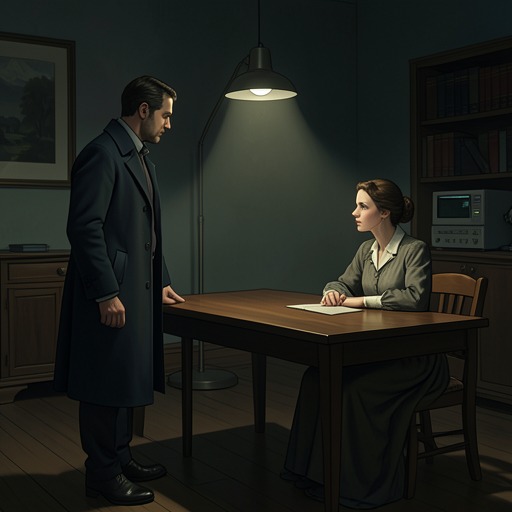
Magic Mirror
The Zone of InterestThe Magic Mirror is the central image in a parable about self-knowledge and evasion. A king’s enchanted mirror reveals the soul rather than the face, but its power becomes most consequential when the speaker identifies the concentration camp with that mirror—with one decisive difference: there is no turning away.
The Mirror in the Tale
An old story tells of a king who commissions his favourite wizard to make a mirror that shows people who they really are. It offers no reassuring reflection of appearance; it exposes the soul. Yet the wizard cannot bear to look into it, and neither can the king or his courtiers. In the expanded telling, a chestful of treasure is offered to any citizen who can keep looking for sixty seconds, but no one succeeds. The reward cannot overcome the fear of what the mirror reveals.
The Camp as Mirror
The speaker applies the tale to the concentration camp, calling it a mirror that reveals its inhabitants to themselves. The analogy turns on the absence of choice: the enchanted mirror can be avoided, but in the camp, as the speaker puts it, “You can’t turn away.” The mirror’s revelation is therefore not a voluntary test of courage; it is an imposed condition of witnessing and exposure.
The speaker’s position among the Sonderkommando prisoners gives this image a specific, brutal weight. He describes the group as the saddest and most disgusting men, and himself as the oldest number among them. The mirror does not simply reveal an abstract inner nature: its truth is encountered from within a situation that the speaker presents as paradoxical and unbearable.
Repetition and Significance
The parable appears first as a story about a king, wizard, and courtiers, then returns in the speaker’s account of the camp. Its repetition transforms a familiar fable into an interpretive frame: the question is no longer only whether anyone can bear to see the truth, but whether anyone living inside the camp can escape that knowledge. The Magic Mirror thus binds self-recognition to enforced witnessing, making the inability to look away the difference between a test and a condition of life.